
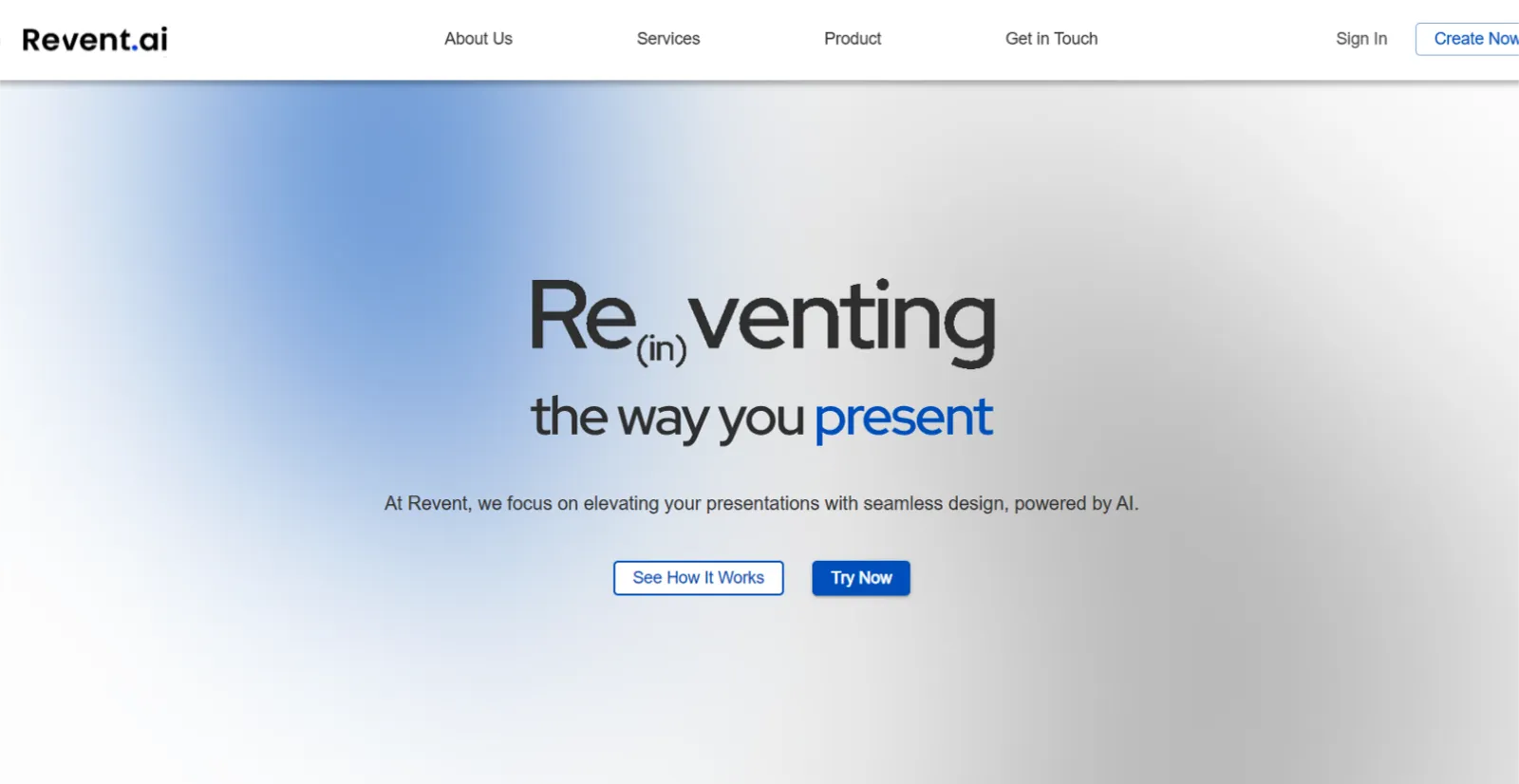
Revent AI let teams without designers turn documents into professional decks in their company's style. Idealite contributed web engineering to the platform.
{ Project Overview }
About the Project
Building a presentation by hand means copying content out of documents, formatting slide after slide and trying to follow company templates. Most people who make decks often, from consultants and sales teams to educators and researchers, are not designers. Revent AI, from India's Revent Solutions Private Limited, set out to take that work away. Its product, Revent Press, launched publicly on Product Hunt in July 2024. Users uploaded a Word file, PDF, report or outline, or typed a prompt, and got a designed deck they could regenerate, edit and export as PowerPoint, as a PDF or as a share link. Themes generated from a company's logo or website kept decks in house style, a free tier let people try before paying, and a Presentations API offered the same export to SaaS, CRM and learning platforms as a second line of business. Idealite's role: web engineering on Revent's presentation platform.
- Industry
- AI
- Services
Web App Development • Front-End Engineering
{ The Challenge }
Hours of Slide Work, Little Brand Consistency
Key Challenges
- Hours lost rebuilding documents as slides
- Deck builders without design skills
- Decks straying from company style
- Infographic slides slow to build by hand
- Platforms lacking built-in PowerPoint export
{ Our Solution }
From Any Document to a Finished, Editable Deck
- Document-to-deck generation
- Logo-based brand themes
- Editable PowerPoint exports
- Free-to-paid plans
- Export API for platforms
{ How We Built It }
Development Process
How the Revent AI engagement came together, step by step.
- 01
Understanding the Deck Problem
Learned how Revent's target users built decks: copying content from documents, formatting by hand and drifting from company templates.
- 02
Web Experience for Non-Designers
Built web screens around Revent's upload-to-deck flow, so people without design skills could reach a finished deck quickly.
- 03
Supporting the Beta
Supported Revent's web presence through its 2024 beta, so early users could find the product and try it ahead of launch.
- 04
Public Launch
Revent Press launched publicly on Product Hunt in July 2024, opening the product to professionals beyond the beta.
{ Tools We Used }
Technology Stack
 React
React
{ Results & Impact }
Delivering Business Value
Decks From Documents
Teams turned existing Word files, PDFs and reports into ready slide decks.
No Designer Needed
Non-designers produced consistent decks in their company's own colors, fonts and layouts.
Fits Existing Tools
Customers kept editing and presenting in PowerPoint or Google Slides as before.
Ready to Sell
Revent could sell paid plans to professionals and an API to platforms.
Technical details
Requirements, architecture, development, testing and deployment notes.
Technical details
Requirements, architecture, development, testing and deployment notes.
Objectives
- Cut Deck-Building Time: Turn existing documents and prompts into designed slides, so users stop rebuilding content by hand.
- Design Without Designers: Give professionals who are not designers decks that look consistent and professional.
- Match Company Style: Apply each company's own colors, fonts and layouts to every deck it produces.
- Fit Existing Workflows: Deliver PowerPoint files, PDFs and share links that work in the tools teams already use.
- Sell to Platforms: Offer presentation export to SaaS, CRM and learning platforms as a second line of business.
Requirements
- Upload of Word, PowerPoint and PDF files, plus pasted text or a prompt, as the source for a deck
- AI slide design that fits layouts to the content, with unlimited regeneration of design options
- Brand themes generated from a company logo or website URL and reused across decks
- In-browser review and editing, with export to editable PPTX, to PDF or as a view-only share link
- Free entry path with no sign-up or credit card, leading into credit-based Premium, Educational and Enterprise plans billed in Indian rupees
- Free text-to-infographic tools for timeline, funnel, cycle, pyramid, SWOT, process, quote and statistics slides
- Enterprise options: full brand integration, a knowledge base for presentations, AI-compatible custom templates, advanced content security and workspace integration
- Presentations API for SaaS, CRM, LMS and education platforms, with API-key access and token-based usage
Architecture
- Marketing site with dedicated converter landing pages for PDF, Word, reports, outlines, research papers and prompts to PPT
- Revent Press web app where users generated, regenerated, edited and exported decks, served from its own subdomain
- Brand-theme generation from a logo or URL, with each theme created once per client and reused on every deck and API export
- Presentations REST API: a transform call takes a source file plus a theme ID and returns slide-image previews or PPTX/PDF downloads
Technology stack
- React single-page app built with Vite, seen on the 2024 site and the Revent Press app
- Next.js with MUI for the later marketing site and converter pages, from late 2024
- REST API at api.revent.ai/core/v1 with API-key authentication
- AWS Route 53 for DNS, with static assets served from a CDN subdomain
Front end
- Upload flow for .docx, .pptx and .pdf files, plus pasted text or prompts
- Revent Press editor to review, regenerate, edit and export generated decks
- Brand-theme generator that works from a company logo or website URL
- Converter landing pages and free text-to-infographic tools usable without sign-up
Back end
- Slide generation from uploaded content, returning slide-image previews and PPTX or PDF downloads
- Brand themes created once per client and applied to every generation and API export
- Presentations API access by API key, with 3 free tokens and then paid token packs
Deployment
- Revent Press app, API and static assets served from dedicated revent.ai subdomains (press, api and cdn1)
Challenges & solutions
- Manual effort: building a deck meant copying content out of Word files, PDFs and reports and formatting every slide by hand.
- Design skills: most people who build decks are not designers, so slides often looked inconsistent or unprofessional.
- Brand consistency: staff skipped or misused company templates, so decks drifted from house style.
- Visual slides: timelines, funnels, SWOT and process infographics are especially slow to build by hand.
- Editable output: decks had to export as editable PowerPoint that also imports into Google Slides, as well as PDF.
- Platform demand: SaaS, CRM and LMS products whose users wanted 'export to PowerPoint' would otherwise have to build and maintain their own slide-generation engine.
- Trial friction: new visitors needed to see a finished deck before committing to a paid plan.
Outcomes
- Professionals turned existing documents and prompts into designed, editable slide decks
- Non-designers produced consistent decks in their company's colors, fonts and layouts
- Decks exported to PowerPoint, PDF or view-only share links, fitting the tools teams already used
- A free entry tier sat alongside paid Premium, Educational and Enterprise plans
- A Presentations API let SaaS, CRM and learning platforms offer presentation export to their own users
Next case study
Vecflow: A Law Firm's Past Work, One Question Away
{ Let's Build Together }
Let's build what's next
We partner with ambitious businesses to design, build and scale digital products that create lasting value.
Contact Us